If you’ve ever taken apart an old toy car, a power drill, or even a small fan, you might’ve noticed a weird little copper ring spinning around in its motor. That’s a commutator, and if you’re shopping for DC motors (which, as a supplier, I know most folks don’t stop to ask about this part until something goes wrong), let me break it down in plain English—no jargon that makes your eyes glaze over. DC Motor

First, let’s start with the basics of how a DC motor works, because you can’t understand the commutator’s job without that. A DC motor runs on direct current, the kind that comes from batteries or power supplies that only send electricity one way. Inside the motor, you have a coil of wire (called an armature) sitting between two magnets. When electricity flows through that coil, it creates its own tiny magnetic field. That field pushes and pulls against the big fixed magnets around it, which makes the armature spin—right? But here’s the problem: if the electricity stayed flowing the same direction through the coil, the spin would stop halfway. Think of pushing a playground swing: if you push it forward, then hold your hand there instead of pushing again as it swings back, it’ll stop. The commutator fixes that.
Let me make that more concrete. The commutator is basically a split ring made of copper, mounted on the motor’s shaft so it spins right along with the armature. There’s also a set of carbon brushes (those little blocks that press against the commutator) that hold steady, connected to the power source. As the armature spins, the commutator’s two segments swap which one is touching the brush that sends positive current and the one that sends negative. That sounds simple, but what does it actually do for the motor’s function? It reverses the direction of the current in the armature coil exactly when needed—right when the coil passes the point where the magnetic pull would stop the spin.
Wait, why is that so important? Let’s say your armature is spinning clockwise. When the coil is at the top of its rotation, the commutator flips the current, so the magnetic field of the coil reverses too. Now instead of being pulled toward the top magnet, it’s pushed away, which keeps the clockwise spin going. If the commutator wasn’t there, the coil would lock up—jittering back and forth a little, but never spinning all the way around. No commutator, no usable rotation; you’d just have a motor that fizzes and whirs but doesn’t turn anything. That’s the kind of thing customers call me about when their motor stalls mid-cycle—9 times out of 10, it’s a worn commutator or misaligned brush, and replacing it fixes the whole system.
Now, I’ve been a DC motor supplier long enough to know that a lot of customers mix up parts, so let’s clear up a common myth. The commutator isn’t what generates the power, or what makes the spin happen in the first place. It’s a timing switch, pure and simple. It’s the part that keeps the motor doing what it’s supposed to do: convert electrical energy into smooth, consistent mechanical rotation. Without it, a DC motor can’t function—period. That’s why when we build our DC motors, we pay way more attention to commutator quality than some of the cheaper manufacturers do. A commutator made with thin, flimsy copper will wear out in a few hundred hours of use, but a properly machined, segmented copper commutator will last tens of thousands of hours, even in heavy-duty uses like conveyor belts, medical devices, or robotics.
Let’s talk about real-world examples so you can see why this matters for your setup. Take a battery-powered golf cart: it runs on DC, right? If the commutator failed, the cart would lurch instead of moving smoothly. Or a sewing machine motor—no commutator, no consistent spin, which means uneven stitches. Even small things like the fan in your laptop use a tiny DC motor with a tiny commutator; if that goes bad, your laptop overheats. I’ve had customers reach out saying their motor for a custom automation line just stopped—turns out their old supplier used a generic commutator that couldn’t handle the constant high speed, and swapping it for a motor with a heavy-duty commutator fixed their whole production line.
Another thing I get asked a lot: does the commutator work the same in all DC motors? Short answer: mostly, but it scales. Tiny motors for phone vibrators have a super small commutator—you can barely see the split in the ring. Big DC motors for electric forklifts have a huge, thick commutator with multiple segments, because they need to handle way more current. The number of segments matters too: more segments mean smoother rotation and less sparking at the brushes, which reduces wear. That’s why when a customer needs a motor for a precision application, like a lab centrifuge, we recommend a motor with a 12-segment commutator instead of a 2-segment one—no wobble, no spark, consistent spin every time.
Wait, what about that spark I mentioned? You might’ve seen faint sparks coming from a motor’s brushes when it’s running. That’s the commutator doing its job—when it swaps the current direction, there’s a tiny arc between the brush and the commutator segment. Normally, that’s totally normal, but if the spark is big or constant, that’s a sign something’s off. Either the commutator is dirty, the brushes are worn down, or it’s the wrong commutator for your current load. As a supplier, we usually check that during testing before a motor leaves our shop, but we always tell customers to keep an eye on that spark—if it gets worse, it’s a quick fix, not a total motor replacement.
Let me circle back to the core function, because it’s easy to get lost in the details. The commutator’s main job is twofold: first, it reverses the current in the armature coil at the correct moment to maintain a continuous, unidirectional spin of the motor’s shaft. Second, it transfers the DC power from the stationary external supply to the spinning armature without tangling wires, which would be impossible if the coil was hardwired to the power source. Think about that: if you tried to run a wire from a spinning shaft to a coil inside, that wire would twist up every time the shaft turned, eventually breaking. The commutator solves that by being a sliding connection—brushes press against the rotating copper ring, so no wires twist, no breaks. That’s a huge part of why DC motors are so reliable, especially compared to older designs that used slip rings (which are for AC motors, by the way—another mix-up I hear all the time).
I know this is a lot, but it’s stuff every customer should know when they’re sourcing DC motors. A lot of suppliers out there will sell you a motor without explaining what each part does, which can lead to choosing the wrong one for your needs. For example, if you’re building a device that needs to run for 24/7, a motor with a cheap, uncoated commutator will fail in weeks. But our DC motors use commutators with a special surface finish that reduces friction and wear, so they last far longer.
At the end of the day, the commutator is the unsung hero of the DC motor. It’s not the biggest part, or the one that makes the loudest noise, but it’s the reason the motor does what it’s supposed to do. Without it, you’d have nothing more than a hunk of metal and wire that fizzes when you turn on the power, no useful motion.
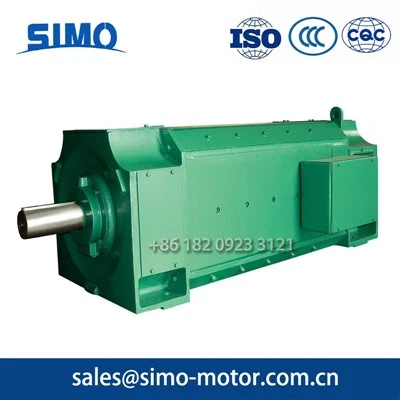
If you’re in the market for DC motors—whether it’s for a small project, a large industrial line, medical equipment, or anything in between—and you want one that’s built to last, with a commutator that’s tested to handle your specific load, reach out to our team for a chat. We can answer any questions you have about motor parts, help you pick the right model, and even work on custom builds if you need something specific. Don’t hesitate to get in touch to make sure you’re getting a motor that works as hard as you do.
Explosion Proof Motor References
- Fitzgerald, A. E., Kingsley, C., & Umans, S. D. Electric Machinery. McGraw-Hill Education, 2003.
- Boldea, Ion. Electrical Machines Drives: Design, Analysis, and Modeling. CRC Press, 2010.
- “DC Motor Commutator Basics.” Electrical Technology, 2022.
Xian Putai Electric Motor Equipment Co., Ltd.
Putai Electric Motor Equipment Co., Ltd. is one of the most professional dc motor manufacturers and suppliers in China, also supports customized service with low price. Welcome to buy advanced dc motor in stock here from our factory. If you have any enquiry about quotation, please feel free to email us.
Address: No.188 Liuhe Road Yangzhou Jiangsu Province, China
E-mail: sales@putaimotor.com
WebSite: https://www.putaimotor.com/
