If you’ve ever shopped for LED drivers—especially for outdoor lighting, marine applications, or high-humidity commercial spaces—you’ve likely noticed a stark price difference between standard models and waterproof LED drivers. As a supplier of waterproof LED drivers, I get this question almost every day: Why are yours so much more expensive than the generic units I can order online for half the price? It’s a fair question, and one that doesn’t have a simple “because we mark up costs” answer. The gap comes down to engineering rigor, material science, and non-negotiable performance standards that most mass-produced standard drivers skip. Let’s break this down, based on what we build every day. Waterproof LED Drivers
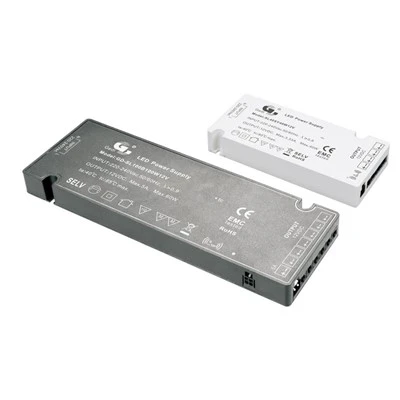
First, let’s ground this in what a waterproof LED driver actually is, versus a standard off-the-shelf driver. A standard LED driver is a compact electronic device that converts alternating current (AC) from a wall outlet into direct current (DC) at a specific voltage and current, tailored to power an LED array. It works fine for indoor use—think under-cabinet kitchen lights, living room recessed lighting, or office ceiling fixtures, where dust and moisture are rare. But take that same driver, stick it in a bathroom vanity where it gets exposed to steam, or mount it on a patio where rain, snow, and temperature swings hit it, or submerge it in a pool or fountain light, and that cheap driver will fail fast. The difference starts with how we build the enclosure.
Standard drivers use thin plastic casings, usually made from low-cost polypropylene or ABS, with tiny vent holes or simple rubber gaskets. These work for indoor low-humidity environments, but they’re not rated for water intrusion. For a driver to be classified as waterproof, it needs an ingress protection (IP) rating—almost always IP65, IP67, or IP68, depending on the application. IP65 means it’s protected against low-pressure jets of water from any direction, and solid particles like dust. IP67 means it can be submerged in up to 1 meter of water for 30 minutes. IP68 is for permanent submersion, up to several meters. To hit even the lowest of these ratings, the casing isn’t just a molded plastic box—it requires precision tooling, hermetic seals, and materials that don’t break down over time.
Let’s talk about the casing materials first. A standard driver’s plastic casing costs pennies to mold. A waterproof driver’s casing? We use materials like glass-filled polycarbonate, aluminum alloy, or even stainless steel for the most extreme applications. Polycarbonate is far more impact-resistant than ABS—it won’t crack if a hailstone hits a patio light, and it won’t fade from UV exposure if it’s mounted outdoors. Aluminum alloy dissipates heat far better than plastic, which is critical because LEDs run hot, and excess heat cuts their lifespan by 50% or more. Wait, heat management is another huge cost driver most people miss. Standard drivers are usually cooled passively via a small, thin heat sink or just the natural airflow around the casing. Waterproof drivers, because their enclosure is sealed, can’t rely on ambient airflow to dissipate heat. That means we have to design internal thermal management systems that move heat from the electronic components to the casing, then out to the surrounding environment—all without creating a leak path. That might mean precision-machined internal heat plates, thermal grease that won’t degrade in water, and even vented heat sinks with secondary seals that keep water out but let excess heat escape. None of that is cheap. The mold for a standard plastic driver casing is a simple two-part tool that costs a few thousand dollars. A waterproof driver’s casing mold? It’s a multi-part tool with tight tolerances (often within 0.1 millimeters) to ensure seals are consistent, and it costs 10 to 20 times more. That tooling cost is amortized over production runs, but for smaller suppliers like us that focus on quality rather than massive volume, that spread is reflected in the final price.
Next, the internal electronics. A standard driver uses cheap, uncoated printed circuit boards (PCBs) and generic electronic components—capacitors, diodes, transistors—rated for indoor, low-humidity environments. Stick that in a sealed, damp enclosure, and moisture will seep into every crack. Over time, that moisture causes corrosion on the PCB traces, leads to short circuits, and kills the driver. To prevent that, we don’t just use a rubber gasket on the enclosure lid—we coat the entire internal PCB and every component with a conformal coating. Conformal coating is a thin, protective layer of epoxy or acrylic that seals every part of the circuit board, repelling water, dust, and even salt spray for marine applications. That coating isn’t cheap. A single liter of quality conformal coating costs $30 to $50, and each driver requires a precise application layer to avoid covering sensitive parts like the LED output connections. Too thick, and it insulates too much heat, killing components; too thin, and it doesn’t provide protection. Some lower-cost waterproof drivers use cheap acrylic coatings that crack over time, especially with temperature swings, but we use industrial-grade epoxy that remains flexible in extreme cold and heat.
We also don’t cut corners on component ratings. Standard drivers might use electrolytic capacitors rated for 1,000 hours of lifespan at 25°C, which is fine for indoor use where temperatures stay consistent. But a waterproof driver that’s mounted outdoors in 100°F heat, or submerged in 80°F pool water, needs capacitors rated for 10,000+ hours of lifespan at 85°C, or even 105°C. Those capacitors cost 3 to 5 times more than the cheap ones, and they’re manufactured to stricter quality standards. The same goes for the integrated circuits (ICs) that regulate the LED current. Generic ICs might work for indoor use, but waterproof drivers need ICs with built-in surge protection, because outdoor power lines are prone to voltage spikes from lightning storms. That surge protection isn’t an add-on; it’s baked into the design, which adds complexity and cost.
Another often-overlooked factor is testing and certification. A standard LED driver might pass a quick continuity test and a basic voltage check before it’s shipped. A waterproof LED driver has to go through a battery of tests to earn its IP rating, and other certifications like UL, CE, or RoHS, which are non-negotiable for commercial and residential outdoor applications. IP testing alone includes spray tests for IP65, submersion tests for IP67/IP68, and temperature cycling tests where the driver is heated to 85°C, then chilled to -40°C, 1,000 times in a row, to ensure no seals break or components fail. Each of these tests costs money—we partner with third-party labs that charge hundreds of dollars per unit for testing, and a failed test means we have to go back to the drawing board on design, materials, or manufacturing. For a supplier that prioritizes reliability, we don’t cut corners on testing; a driver that fails in a customer’s outdoor light isn’t just a bad unit—it damages that customer’s project, or even causes a safety hazard if it’s a pool light. The cost of that testing is passed on to customers, and it’s a big part of the price difference.
Then there’s the demand for long-term reliability. Standard drivers might last 20,000 hours, or about 2 years of continuous use. A waterproof LED driver, by design, is built to last 50,000 to 100,000 hours, which means it can keep running for 5 to 10 years, or even longer, in harsh environments. For commercial applications like municipal street lights, airport runway lights, or resort pool lighting, replacement costs are huge—you have to dispatch technicians, rent lifts or boats, and shut down parts of the site to replace a failed driver. A $10 waterproof driver might cost $50 up front, but if it lasts 10 years instead of 2, it’s actually a better value. That longevity comes from every part of the design, not just the enclosure.
I also see a lot of customers compare our waterproof drivers to cheap “waterproof” drivers sold by big-box retailers or Amazon sellers. A lot of those units are labeled IP65, but they’re barely meeting the minimum standard—they’ll handle a light rain, but not a heavy downpour, and they’ll definitely fail if submerged. We build our drivers to exceed the IP rating, not just meet it. For example, our IP67 drivers are tested to 1.5 meters of water for 24 hours, not the 0.5 meters and 30 minutes required by the standard. That extra margin is what gives customers peace of mind, and it’s why we can offer a 5-year warranty on most of our waterproof drivers, while cheap competitors often only offer a 1-year or even no warranty at all.
So what does all this add up to? Let’s do a quick breakdown, based on our internal costs, to make it concrete. A standard driver for indoor use: low-cost casing, uncoated PCB, generic components, minimal testing, no thermal management. Total cost for us to manufacture: roughly $5 to $8, which is why they retail for $10 to $15. Our waterproof driver for IP67 outdoor use: precision-molded polycarbonate casing with a silicone gasket, thermal management system, epoxy-conformal coated PCB, high-temperature capacitors and ICs, third-party IP certification, 5-year warranty. Total manufacturing cost: $25 to $35, which translates to a retail price of $50 to $70. That’s not a markup—that’s the cost of materials, engineering, testing, and quality control to make a product that actually works as advertised in harsh environments.
I get it—when you’re pricing a project, especially a large one with dozens or hundreds of drivers, the up-front cost is a big factor. But I’ve seen too many customers cut corners on waterproof drivers and end up paying far more in the long run. Last year, a landscaping company reached out to us after they installed 200 cheap waterproof drivers for a residential pool project. Within 6 months, 40 of them had failed—some had shorted out when the chlorine level got too high, others had cracked casings from sunlight, and a few had corroded circuits from regular submersion. They ended up having to replace all 200 drivers, at a cost that was almost triple what it would have been if they’d chosen our drivers in the first place. That’s the lesson: waterproof drivers aren’t just a slight variation of standard drivers—they’re a entirely different product, built for entirely different conditions.

If you’re in the market for a waterproof LED driver—whether for outdoor lighting, marine applications, food processing equipment, or any space where moisture or dust is a risk—don’t just shop for the lowest price. Ask about the IP rating, the casing material, the conformal coating, and the warranty. Those are the details that separate a driver that works for years from one that fails within months. As a supplier, we’re focused on making drivers that deliver on their promises, not cutting corners to undercut competitors. If you’re ready to discuss your specific application, or have questions about which waterproof driver is right for your project, we’re here to help with transparent, no-obligation consultations.
2.4G Dimmable LED Driver References
- American National Standards Institute (ANSI). Standard for Lighting of Roadways ANSI/IESNA RP-6-16. New York: Illuminating Engineering Society, 2016.
- International Electrotechnical Commission (IEC). Standard for Ingress Protection Rating for Enclosures IEC 60529:2013. Geneva: International Electrotechnical Commission, 2013.
- Electronics Industry Alliance (EIA). Conformal Coating Materials and Application Guidelines EIA-CC-A-816. Arlington, VA: Electronic Industries Alliance, 2018.
- LED Lighting Facts. “Life Expectancy of LED Drivers: A Comparative Analysis of Standard vs. Harsh Environment Rated Units.” Portland, OR: U.S. Department of Energy, 2021.
- Underwriters Laboratories (UL). Standard for LED Drivers UL 8750. Northbrook, IL: UL LLC, 2020.
Foshan Gedi Electrnoic Co., Ltd.
As one of the most professional waterproof LED drivers manufacturers in China, we’re featured by quality products and good price. Please rest assured to buy advanced waterproof LED drivers for sale here from our factory. If you have any enquiry about cooperation, please feel free to email us.
Address: 4th Floor, Building 8, South District, Huayi Decoration City, No.10, Laixiang Road, Shiwan Sub-district, Chancheng District, Foshan City, Guangdong Province, China.
E-mail: market@gedi-lighting.com
WebSite: https://www.gedi-lighting.com/
